
0SPX AutoTrades · Weekly Investment Commentary
0SPX Market Perspective
The AI Selloff, Rising Volatility & Where We're Finding Opportunity
If there's one thing that stood out to me this past week, it's just how quickly market sentiment can change.
We've gone from investors aggressively buying anything associated with artificial intelligence to suddenly questioning valuations, infrastructure spending, and whether some of these companies can justify the expectations built into their stock prices.
Friday was particularly ugly. The Nasdaq Composite dropped roughly 5.3%, the S&P 500 fell 3.7%, and volatility surged as investors rushed to reduce risk.
But here's where I think things get interesting.
While there are certainly reasons to be cautious, I also believe we're beginning to see some opportunities develop, particularly in companies that have experienced significant corrections despite continuing to demonstrate strong underlying businesses.
I'm not suggesting we've found the bottom, because nobody knows that. But I do think this is a good time to step back, look at what's happening beneath the surface, and start thinking about where we want our capital positioned over the longer term.
Here are a few things I'm paying particularly close attention to this week.
1. The AI Boom Is Facing Some New Challenges
I still believe artificial intelligence will be one of the biggest technological transformations of our lifetime. However, I think investors are starting to realize that building the infrastructure to support it isn't going to be as straightforward as initially anticipated.
Think about what it actually takes to build these massive data centers. We're talking about enormous electricity requirements, cooling infrastructure, land, semiconductor equipment, permitting, and billions of dollars in capital expenditures.
And now we're beginning to see another challenge emerge: political opposition.
Data-center development is becoming a bigger political issue, particularly in communities concerned about electricity costs, water consumption, and the strain these facilities can place on local infrastructure.
My concern isn't necessarily that AI demand is disappearing. It's whether investors have gotten ahead of themselves when pricing in how quickly and profitably this infrastructure can be built.
There's a big difference between believing in the future of AI and believing every company involved in the AI ecosystem is currently worth what the market says it is.
What I'm watching: Whether infrastructure constraints and rising costs begin affecting the growth expectations investors have assigned to semiconductor companies, data-center operators, and the broader technology sector.
2. Anthropic Goes Public, and There's an Interesting Side to This Story
Another development worth discussing is Anthropic's highly anticipated IPO.
The company behind Claude AI made its public-market debut on November 19, raising approximately $81.3 billion in what was widely reported as a record IPO (before underwriters later exercised their overallotment option).
But there's another aspect of this that I find particularly interesting, and it has to do with institutional money.
MSCI has announced Anthropic's addition to the Large Cap segment of its Global Standard indexes, effective December 1, 2026.
When a company enters a major index, funds and ETFs tracking that index generally have to adjust their holdings to reflect the new composition.
That can create additional buying demand for the newly included company, while potentially changing allocations across existing holdings.
It's worth remembering that these funds aren't necessarily making an independent decision to sell one company because they dislike it. They're adjusting their portfolios to follow the index.
Still, when you introduce a company of this size into an already concentrated technology market, it's something investors should pay attention to.
My takeaway: We're seeing the AI investment universe expand, but we're also seeing changes in how institutional capital may be distributed across the market.
3. The VIX Above 30. What Does That Actually Tell Us?
One indicator I've been watching closely is the VIX, which measures the market's expected volatility based on S&P 500 options pricing.
On Friday, November 20, the VIX closed at 35.89 after reaching an intraday high of 40.03.
For comparison, it closed at 19.30 on November 13, just one week earlier.
That's a substantial increase in a very short period.
When the VIX moves above 30, it generally tells us that investors are becoming considerably more concerned about near-term market conditions.
Here's what I think investors should understand:
- Larger daily swings are becoming more likely.
- Portfolio drawdowns can accelerate quickly.
- Position sizing and leverage become much more important.
- Options premiums tend to increase as implied volatility rises.
- Significant selloffs can create opportunities, but they can also continue much longer than expected.
One thing I always like to emphasize is that an elevated VIX doesn't necessarily mean we're at a market bottom.
Sometimes volatility spikes near major market lows. Other times, it remains elevated throughout an extended correction.
My takeaway: This is exactly the type of environment where capital preservation matters. We don't need to catch every move, and we certainly don't need to rush into the market just because prices are falling.
4. What the Charts Are Telling Us
Beyond the headlines, I've also been spending time looking at the technical picture across the major indexes.
I think it's important to separate what we're hearing in the news from what the market is actually doing.
The Nasdaq has taken a significant hit, particularly across semiconductor and AI-related stocks. In last week's commentary, we talked about a potential bounce off the daily 300 EMA. Since then, MNQ has continued lower through its shorter-term moving averages rather than finding that bounce.
I'm also keeping an eye on the S&P 500 to see whether this weakness continues spreading across the broader market.
But there's another timeframe I think deserves our attention right now: the monthly chart.
When we're evaluating longer-term opportunities, I like to look beyond the daily noise and identify where the major monthly moving averages are sitting.
That's where things get particularly interesting.
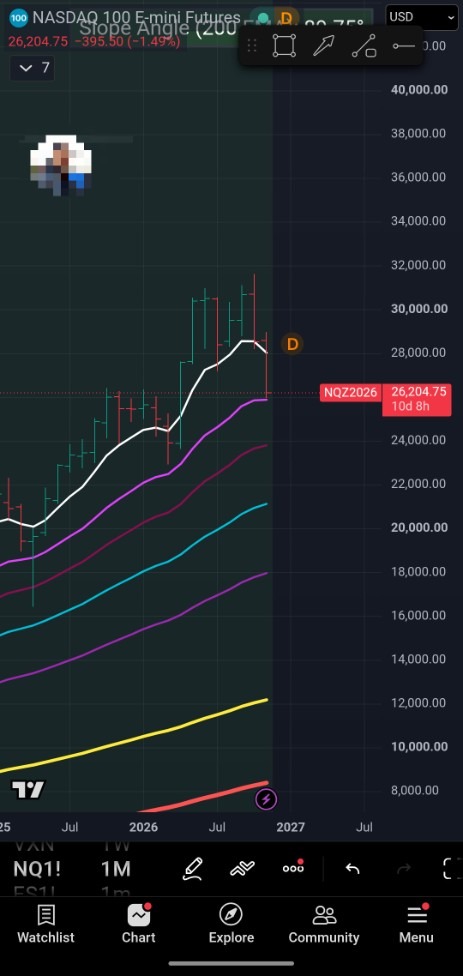
Nasdaq Futures (NQ): Approaching the 21-Month EMA
The Nasdaq futures have experienced a substantial correction, and we're now approaching an area I've been watching closely: the rising 21-month exponential moving average.
This is an important longer-term reference point because it helps us evaluate the broader trend beyond the day-to-day market fluctuations.
What's interesting is that despite the recent selling pressure, the Nasdaq is approaching this longer-term moving average rather than having completely broken down through its broader monthly trend structure.
I'm watching to see whether buyers begin stepping in around this area.
If we see stabilization and a meaningful reaction off the 21-month EMA, it could present an interesting bounce opportunity.
Of course, if price breaks decisively below it, we'll need to reassess. I'm not interested in assuming support will hold simply because it's a moving average.
For now, this is an area I'm paying very close attention to.
NVIDIA (NVDA): Testing the 50-Month EMA
We're seeing something equally interesting with NVIDIA.
After its substantial correction, the stock has come down toward its 50-month exponential moving average.
That's a significant longer-term technical reference, particularly considering how far the stock has moved over the past several years.
I'm watching to see whether this area attracts longer-term buyers and whether we begin seeing signs of stabilization.
A successful defense of the 50-month EMA could provide an interesting starting point for a recovery attempt.
However, if the stock continues breaking lower, we'll need to remain patient and evaluate the next potential support areas.
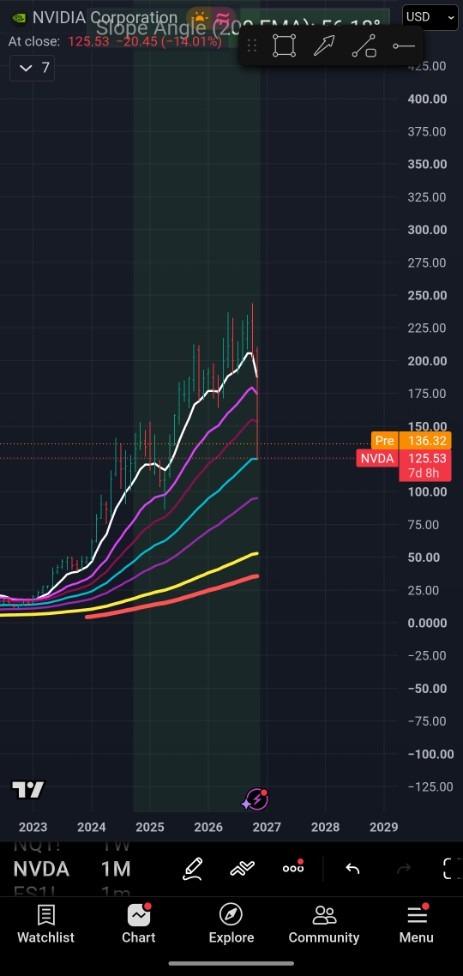
The bigger picture: Both the Nasdaq and NVIDIA are approaching longer-term monthly moving averages that I believe deserve our attention. We're beginning to see areas where the risk/reward of a potential bounce becomes increasingly interesting.
5. How Our Algorithms Are Navigating This Sell-Off
Something I also wanted to touch on is how our automated trading systems have been handling the recent market conditions.
In last week's commentary, we discussed the potential for a bounce off the daily 300 EMA.
Since then, we've continued to see the Nasdaq push lower, moving through its daily EMAs one after another rather than finding that bounce.
This is precisely the type of environment where I want our systems to remain disciplined.
Our algorithms have largely been patient rather than aggressively trying to catch every dip.
We did capture a few profitable trades along the way, and the very last trade exited around breakeven as the market continued moving against the broader directional setup.
I actually like seeing this type of behavior.
The objective isn't to force trades simply because the market is moving. It's to participate when our conditions are met, manage risk when they aren't, and preserve capital when the market isn't offering an attractive setup.
Our FUEL strategy is a good example of this approach.
We've continued to monitor its performance as the Nasdaq has worked through its daily moving averages, and the system has demonstrated the patience we want to see during these conditions.
What's particularly important is that when the market eventually begins stabilizing, our systems can look for new opportunities without having exhausted their capital trying to predict the bottom.
That gives us the flexibility to participate in a potential recovery while continuing to prioritize risk management.
Our systems don't need to participate in every move. Remaining patient during a selloff preserves our ability to participate when more favorable opportunities develop.
6. Investment Spotlight: NVIDIA (NVDA)
Why we're beginning to build a long-term position during this correction.
This is probably one of the more interesting opportunities I'm looking at right now.
NVIDIA has experienced an extraordinary selloff, closing Friday at $125.53, down approximately 48% from its 52-week high of $243.37.
That's a substantial correction for one of the most strategically important companies in the technology industry.
But here's what caught my attention.
NVIDIA recently reported quarterly revenue of approximately $115.8 billion, representing growth of 103% year over year.
Its Data Center business alone generated approximately $107.6 billion in revenue, up 110% from the previous year.
We're talking about a company continuing to generate extraordinary growth while its stock is experiencing one of its most significant corrections.
So, what exactly is the market worried about?
There are legitimate concerns. Investors are questioning the sustainability of AI infrastructure spending, competition is increasing, and there are uncertainties surrounding future growth expectations.
Those are things we absolutely need to take seriously.
But I also think it's important not to lose sight of the bigger picture.
NVIDIA remains deeply embedded in the infrastructure powering modern artificial intelligence. Its GPUs, networking technology, and software ecosystem have established an important competitive position.
I believe the long-term demand for accelerated computing will remain significant, even if the market needs time to digest the enormous investments being made today.
What the technicals are telling us
The technical picture has become particularly interesting.
As of Friday's close:
- Share price: $125.53.
- Approximately 48% below its 52-week high.
- Daily RSI: approximately 15 (extremely oversold on the daily timeframe; stocks can remain oversold longer than expected).
- Trading substantially below its shorter-term moving averages.
- Approaching its 50-month EMA on the monthly chart.
An RSI around 15 is an extremely oversold reading. That doesn't mean NVIDIA can't go lower. Stocks can remain oversold for extended periods, particularly during aggressive market corrections.
But it does tell us something about the intensity of the selling.
What we're doing about it
We've actually started building a long-term position in NVIDIA, initially allocating approximately 3% of our portfolio.
We're not looking to put all our capital to work at once, and we're certainly not trying to call the exact bottom.
Instead, the idea is to build our exposure gradually as opportunities develop.
If the stock continues declining, we'll have the flexibility to evaluate additional entry points. If the market begins stabilizing, we'll already have exposure established.
We're particularly interested in how the stock responds around its 50-month EMA, as this could become an important area for a potential longer-term bounce.
Of course, there are risks. The AI spending cycle could slow, competition could intensify, and valuations could compress further.
But from a long-term perspective, I believe NVIDIA deserves serious consideration as we evaluate opportunities created by this correction.
My thinking is simple: I don't want to buy a stock just because it's down 40% or 50%. I want to understand what I'm buying, why the market is selling it, and whether the underlying business still supports the long-term investment thesis.
In NVIDIA's case, I believe there's a compelling opportunity worth exploring, provided we remain disciplined about how we build the position.
7. Something Else to Consider as We Approach Year-End: Tax-Loss Harvesting
With the end of the year approaching, there's another consideration investors shouldn't overlook.
For those holding investments that have declined significantly, this may be an opportunity to review their portfolios for potential tax-loss harvesting.
Essentially, investors can realize certain investment losses to offset realized capital gains elsewhere in their portfolios.
There are some important rules to understand, particularly wash-sale restrictions, holding periods, and the tax treatment of short-term versus long-term gains.
It's also important not to sell a fundamentally attractive investment solely for tax reasons without considering your overall strategy.
I think tax efficiency is an important part of managing a portfolio, especially during years when markets experience significant volatility. Tax considerations should complement investment decisions, not dictate them.
If you haven't reviewed your portfolio heading into year-end, now would be a good time to do so. As always, consult your tax professional for advice specific to your situation.
Looking Ahead: Where Do We Go From Here?
I think the next few weeks will be particularly important.
We're entering a period where investors are reassessing valuations, AI spending, and the broader economic outlook. At the same time, we're beginning to see some companies trade at substantially lower prices than they did just a few weeks ago.
I'm not convinced we've seen the worst of the correction, but I'm also not interested in sitting on the sidelines simply because the market has become uncomfortable.
There is a difference between being cautious and being completely inactive.
We'll continue watching the major technical support levels, monitoring volatility, and evaluating opportunities in companies we believe have strong long-term prospects.
NVIDIA is one example of where we've started putting that philosophy into action. Meanwhile, our automated systems continue to wait for favorable conditions rather than forcing trades in an increasingly volatile environment.
If there's one thing I want investors to take away from this week's commentary, it's this:
We don't have to predict the market to take advantage of it. We just need to be prepared when opportunities present themselves.
I'd rather have the flexibility to take advantage of a market dislocation than find ourselves overextended when the next opportunity comes along.
That's the approach we're taking as we navigate the current environment.
Until next week,
Important Information
This commentary is intended for informational and educational purposes only and does not constitute individualized investment advice or a recommendation to buy or sell any security. All investments involve risk, including the potential loss of principal. Futures trading involves substantial risk and is not suitable for every investor. Past performance and historical chart measurements do not guarantee future results. Technical levels may fail, and losses can exceed expectations. Investors should consider their individual circumstances and consult their investment and tax professionals where appropriate.